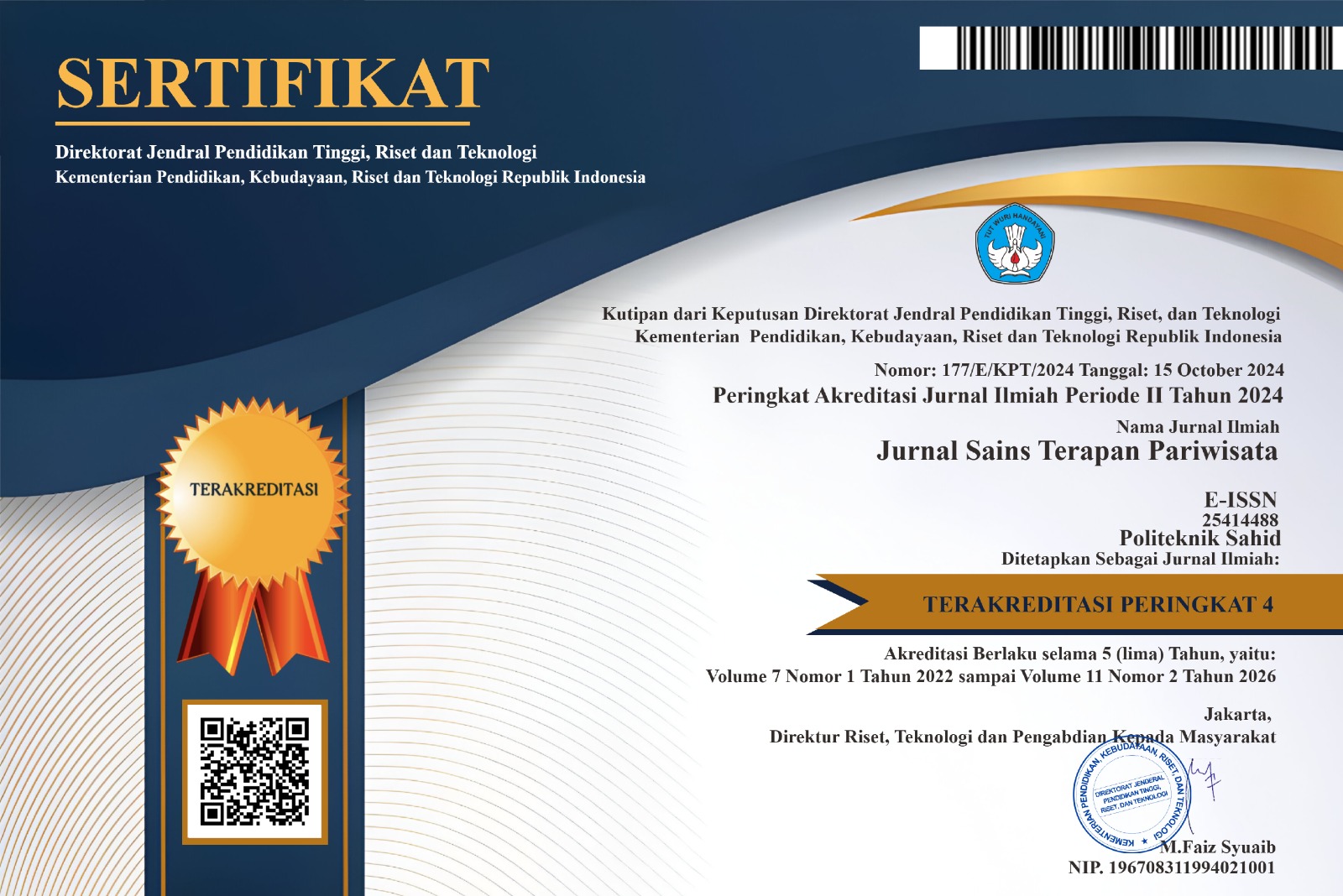
ACCREDITATION CERTIFICATE
MENU

ISSN
E-ISSN
P-ISSN
TEMPLATE ARTIKEL
VISITOR
LICENSE

Karya ini dilisensikan pada Creative Commons Attribution 4.0 International License.

The Jurnal Sains Terapan Pariwisata (JSTP) is a professionally managed academic journal published by Politeknik Sahid, upholding the highest standards of copyright, privacy, and scientific publication ethics. Each article published focuses on the fields of tourism, gastronomy, and hospitality. The manuscripts are written by competent authors in their respective disciplines and are derived from scholarly studies or research findings. Every article embodies values of novelty, originality, and usefulness.
To enhance the quality of the journal and the professionalism of authors, editors, reviewers, and journal managers, the JSTP Scientific Publication Ethics has been established. This code of ethics aims to prevent malpractice in journal publication and to ensure protection against copyright violations such as duplication, fabrication, falsification, and plagiarism.
Author Ethics
Reporting: Authors must report their research processes and findings honestly, clearly, precisely, accurately, comprehensively, and objectively, while maintaining complete records of their research data. Authors are expected to uphold integrity in presenting all data and information contained within their manuscripts and research results.
Originality: Authors must declare that the submitted manuscript is original, derived from their own ideas, and has not been previously submitted or published in any media, in any language, nor is it under consideration by another publisher. In cases of duplicate publication or fraudulent submission, authors agree that their articles will be withdrawn from this journal.
Clarity of Sources: Authors must ensure that all references and sources cited in the text and listed in the bibliography are complete and clearly stated. It is strictly prohibited to quote or use the work of others without proper citation of the original source.
Responsibility: Authors bear full responsibility for the data and research results they present, including methodology, analysis, calculations, and details. If verification is required by the editor or reviewer, authors must respond promptly, clearly, and truthfully.
Authorship Agreement: Authors must ensure that all names listed as authors have contributed significantly to the conception and development of the manuscript and that all have agreed to the final version. Any changes in authorship additions, removals, or reordering must be approved by all authors. If external parties have contributed in a non-substantive manner to the completion of the manuscript, the authors must acknowledge them appropriately in the acknowledgments section.
Timeliness: Authors are expected to revise their manuscripts promptly following the review and editing process to maintain the discipline and consistency of the journal’s publication schedule. Failure to meet deadlines may result in the postponement of the article’s publication.
Disclosure of Conflicts of Interest: Authors must respect copyright and privacy rights to prevent conflicts of interest. Should any conflict of interest arise with other parties, authors are required to resolve it fairly and prudently.
Editorial Ethics
Neutrality: Editors must maintain neutrality in selecting and screening manuscripts. They are required to be objective and fair to all authors who submit their works and must not discriminate against any author on the basis of gender, ethnicity, religion, race, social group, or nationality.
Reporting: Editors must report the results of manuscript selection and review to authors clearly and accurately, paying attention to the precision, completeness, and clarity of the research reporting and development process. This includes editorial techniques and adherence to publication and writing guidelines.
Communication: Editors must communicate effectively and efficiently throughout the publication process. All feedback, comments, or criticism from authors, reviewers, and journal managers should be addressed clearly, honestly, and transparently.
Fairness: Editors must distribute manuscripts fairly among the editorial team and reviewers according to their respective competencies.
Professionalism: Editors must carry out their duties professionally, in accordance with their responsibilities. They must understand all policies related to journal publication and ensure that each manuscript undergoes a proper, fair, and objective editorial and review process.
Responsibility: Editors hold full responsibility for the successful publication of the journal. They must ensure that every published article is an original, non-plagiarized work that contributes positively to the readers and scholarly community.
Disclosure of Conflicts of Interest: Editors must respect copyright and privacy rights to prevent conflicts of interest. Should a conflict arise, editors must resolve it fairly and prudently.
Reviewer Ethics
Neutrality: Reviewers must act honestly, objectively, independently, and free from bias, adhering only to scientific truth. The review process must be conducted professionally without regard to the authors’ backgrounds. Reviewers are prohibited from evaluating manuscripts in which they have any direct or indirect involvement.
Professionalism: Reviewers must maintain a critical and professional attitude when assessing manuscripts, providing evaluations within their area of expertise. They must be open to new ideas, maintain confidentiality of the manuscripts, refrain from using any content for personal gain, and be committed to improving the quality of the work under review. Reviewers have the right to decline a review if the manuscript lies outside their expertise and may recommend a more competent reviewer.
Quality Assurance: Reviewers are responsible for assisting editors in improving the quality of manuscripts. Their review should focus on substantive content rather than grammar or typographical errors. Reviewers must adhere to fundamental principles of scientific analysis, emphasizing truth, novelty, and originality, while considering the manuscript’s contribution to the advancement of knowledge, technology, and innovation.
Timeliness: Reviewers must provide prompt feedback to editors and are expected to complete reviews within the designated timeframe. If additional time is required, reviewers should notify the editor with a clear justification to maintain discipline and regularity in the journal’s publication process.
Disclosure of Conflicts of Interest: Reviewers must respect copyright and privacy rights to prevent conflicts of interest. Any conflicts with other parties must be resolved fairly and wisely.
Journal Management Ethics
Decision-Making: Journal managers must articulate the vision, mission, and objectives of the publication in accordance with the Research and Community Service Center (P3M) of Politeknik Sahid. Decisions must consider recommendations from reviewers and the editorial board and remain neutral, free from individual, institutional, business, ethnic, religious, racial, or social biases.
Independence: Journal managers must provide editors and reviewers with the freedom to foster a respectful and collaborative working environment, ensuring the protection of intellectual property rights, especially in managing funds received from third parties. Managers should encourage the implementation of ethical clearance standards, including confidentiality, permissions, and specific ethical requirements for research involving humans, animals, or other living beings.
Responsibility: Journal managers are responsible for the journal’s publication policy guidelines, including the determination of the publication title, scientific scope, writing style, collaborations, permissions, legalities, and evaluation of published manuscripts.
Promotion: Journal managers must promote and ensure the sustainability of the publication. They have the authority to determine funding in accordance with the journal’s policy and publication needs. Funding sources must be disclosed transparently in the publication without influencing the content or interpretation of the research.
Disclosure of Conflicts of Interest: Journal managers must uphold copyright and privacy rights to prevent conflicts of interest. Should a conflict occur, it must be resolved fairly, transparently, and prudently.
E-ISSN
P-ISSN

Karya ini dilisensikan pada Creative Commons Attribution 4.0 International License.